StakeUS Originals Games Explained
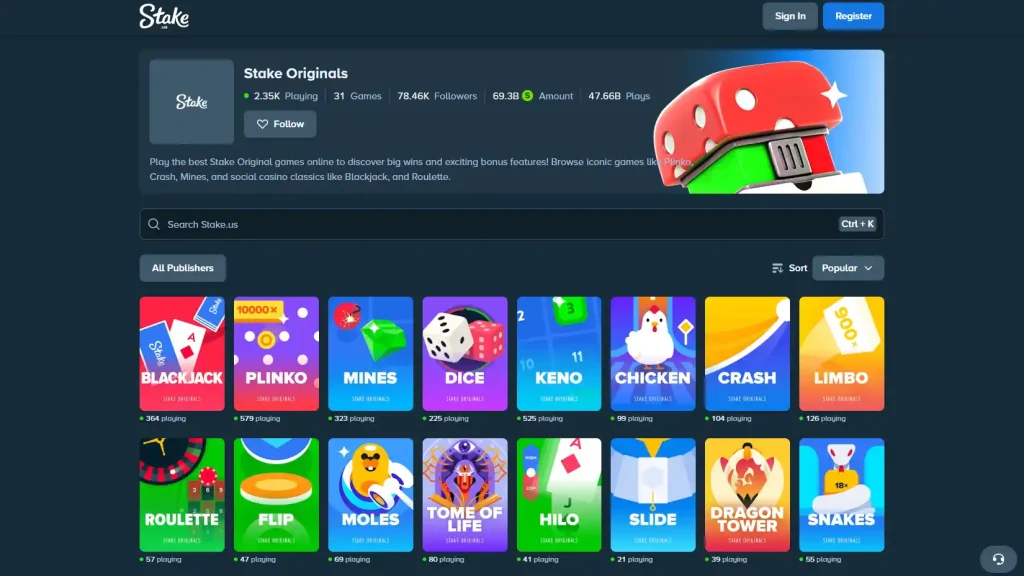
Table of Contents
- Five named Originals form the clearest proprietary core
- The titles fall into different mechanic types even when the interface stays simple
- Provably fair verifies the outcome process, not whether the game is favorable
- A typical provably-fair check starts before the result is revealed
- Fast mechanics can amplify short-session variance
- Originals sit beside third-party studios and reported exclusive content
- Stake Originals FAQ
- Provably fair improves verifiability without changing the mathematics of risk
Section element
Stake Originals · 2026
Stake Originals are a proprietary provably-fair game family inside StakeUS. Titles include Plinko, Crash, Mines, Dice and Limbo. Their mechanics differ, but the same analytical rule applies across the group: provably fair can help verify how an outcome was produced, while RTP, house edge and short-term variance remain separate questions.
Section element
Plinko, Crash, Mines, Dice and Limbo are easier to compare when you look at the decision each game asks you to make: choose a path, choose an exit point, reveal positions, set a probability threshold or target a multiplier. Those mechanics shape session risk more directly than the visual theme around them.
- Game familyStake Originals
- Named titlesPlinko, Crash, Mines, Dice, Limbo
- Fairness modelProvably fair
- Mechanic stylesPath, multiplier, grid, probability
Five named Originals form the clearest proprietary core
Stake Originals include Plinko, Crash, Mines, Dice and Limbo. They sit apart from third-party provider games because they belong to Stake’s own named game family and are described as provably fair.
That does not make the five titles interchangeable. The decision structure changes from game to game, which affects how quickly risk accumulates and how much control a player feels during a round. A simple interface can still produce high variance, especially when rounds resolve quickly and can be repeated in rapid succession.
Plinko
The central idea is path uncertainty: a dropped object passes through a field of possible routes before landing in an outcome zone. The visual path is intuitive, but individual outcomes remain random.
Crash
The mechanic revolves around an increasing multiplier and an exit decision. The tension comes from choosing when to stop before the round ends.
Mines
The game uses successive grid choices. Each reveal creates a new decision about whether to continue taking exposure or stop the round.
Dice
A probability threshold drives the round. The interface is compact, which can make the underlying risk feel simpler than it is over repeated plays.
Limbo
The player targets a multiplier-style outcome. It strips the experience down to a direct relationship between probability and potential payout size.
The titles fall into different mechanic types even when the interface stays simple
A useful way to compare Originals is to classify the decision they put in front of you. This is an editorial mechanic map rather than a claim about return percentages. It helps explain why two games can both be fast and minimalist while producing very different player behavior.
| Title | Mechanic lens | Main player decision | Practical risk cue |
|---|---|---|---|
| Plinko | Path / landing outcome | Select the setup, then accept the random path | The animation does not make the result more predictable |
| Crash | Rising multiplier | Choose an exit point before the round ends | Waiting longer increases exposure to a sudden loss of the round |
| Mines | Sequential grid selection | Continue revealing or stop | Each additional choice extends the risk sequence |
| Dice | Probability threshold | Set the target condition | Fast repeats can make variance accumulate quickly |
| Limbo | Multiplier target | Select a target before resolution | Higher targets generally imply lower hit frequency as a mathematical concept |
The wider StakeUS games and providers guide shows where Originals sit beside third-party studios and reported exclusive titles.
Provably fair verifies the outcome process, not whether the game is favorable
Stake Originals are described as provably fair. In general, a provably-fair system uses cryptographic commitments so that the inputs behind an outcome can be checked after a round rather than simply trusted as an opaque server result. The purpose is integrity of outcome generation, not a promise that the player has positive expected value.
What provably fair can address
- Whether a committed cryptographic input was changed after the wager was placed.
- Whether the published verification process reproduces the recorded outcome from the relevant inputs.
- Whether a player can independently inspect the fairness mechanism rather than relying only on visual animation.
What it does not establish
- It does not make a losing game mathematically favorable.
- It does not remove the house edge or short-term variance.
- It does not supply an RTP figure when one has not been published or independently audited.
Provably-fair status should not be used to infer an RTP or house-edge percentage. Those are separate game parameters and should be evaluated independently from the fairness-verification process.
A typical provably-fair check starts before the result is revealed
The cryptographic idea is easiest to understand as a sequence. Exact interfaces differ across implementations, so this is a general explainer rather than a description of a specific StakeUS verification screen.
- A secret input is committed. The system publishes a cryptographic commitment, commonly a hash, before revealing the underlying secret.
- Another input contributes to the round. A client-side value, nonce or comparable input can become part of the calculation, depending on the implementation.
- The game resolves. The combined inputs are processed according to the game’s deterministic outcome function.
- The hidden value can later be revealed. A player can hash the revealed value and compare it with the earlier commitment.
- The recorded result can be recomputed. If the published inputs and algorithm reproduce the round, the check supports the claim that the committed data was not silently replaced after the fact.
This verification logic is useful because it focuses on tamper evidence. It still does not answer whether the probability distribution is attractive to the player. Fair generation and favorable economics are separate properties.
Fast mechanics can amplify short-session variance
Originals such as Crash, Dice, Mines and Limbo can resolve quickly and invite repeated decisions. That pace matters. Even when every round is generated fairly, a high number of rounds in a short period can produce large swings simply because more outcomes are being sampled.
- Outcome integrity
- Whether the result follows the committed verification process.
- Expected return
- The long-run mathematical return implied by the game’s rules; no StakeUS-specific figure is stated here.
- Variance
- How widely short-run results can swing around a long-run expectation.
- Session exposure
- How much total play accumulates through stake size, round count and session length.
These concepts solve different questions. Provably fair can support confidence in how a recorded round was generated. Expected return addresses the long-run cost built into a game. Variance explains why actual short sessions can end far above or below that expectation. Session exposure is the part a player can directly control.
Originals sit beside third-party studios and reported exclusive content
Stake Originals are one layer of the wider StakeUS game catalog. The broader provider list includes Pragmatic Play, Hacksaw Gaming, Nolimit City, Twist Gaming, Massive Studios, Titan Gaming and Big Time Gaming. Separate coverage also reports more than 20 exclusive games, including content associated with Nolimit City.
That gives the lobby three distinct ways to discover content: familiar third-party studios, exclusive titles and proprietary Originals. If you prefer known supplier patterns, the third-party layer is the natural starting point. If you want compact mechanics and a fairness-verification angle, Originals are the more distinctive branch.
Third-party studios
Useful when you already recognize a provider’s interface or game design and want continuity across platforms.
Exclusive titles
Useful when the catalog difference itself matters and you want content reported as specific to StakeUS.
Stake Originals
Useful for direct, compact mechanics where provably-fair verification is part of the product concept.
The separate StakeUS VIP guide explains progression and rakeback as account-level mechanics. Those rewards should remain separate from the question of whether a particular game mechanic fits your preferred risk and session style.
Stake Originals FAQ
Which Stake Originals are listed for StakeUS?
Named Stake Originals include Plinko, Crash, Mines, Dice and Limbo.
Are Stake Originals provably fair?
Yes. The Stake Originals family is described as provably fair, meaning outcome generation can be checked through a cryptographic verification process.
Does provably fair mean there is no house edge?
No. Provably fair addresses whether the outcome-generation process can be verified. It does not remove a house edge, guarantee profit or eliminate variance.
Does provably fair tell me a game’s RTP?
No. Provably fair addresses outcome verification. RTP and house edge are separate game parameters, so fairness verification should not be used as a substitute for either figure.
How should I compare the Originals?
Compare the decision mechanic first: Plinko uses path uncertainty, Crash uses an exit decision, Mines uses sequential grid choices, Dice uses a probability threshold and Limbo uses a multiplier target.
Provably fair improves verifiability without changing the mathematics of risk
Stake Originals give StakeUS a distinct proprietary layer built around Plinko, Crash, Mines, Dice and Limbo. Their most important shared feature is provably-fair outcome verification, but that feature should be kept in its proper lane: it can help test whether a committed process produced a recorded result, while RTP, house edge, variance and session exposure remain separate. Compare the games by mechanic, set session boundaries before fast rounds begin, and avoid treating cryptographic verifiability as evidence of favorable expected returns.
Recommend

StakeUS Games and Providers
StakeUS Section element StakeUS games · 2026 StakeUS combines a broad third-party game catalog with...

StakeUS VIP and Rakeback
StakeUS Section element StakeUS VIP · 2026 StakeUS runs a five-tier VIP structure built around...

StakeUS Bonus and Daily Rewards Explained
StakeUS Section element StakeUS rewards · 2026 StakeUS rewards are built around Gold Coins and...
StakeUS Payments and Crypto Purchases Explained
StakeUS Section element StakeUS payments · 2026 Crypto sits at both ends of the StakeUS...
StakeUS License and Legal Model Explained
StakeUS Section element StakeUS access and rules · 2026 StakeUS uses a US social and...